Aircraft OEM Manufacturers · Software
The simulator is a data product; your flight test data should not become theirs.
simulation software engineered so validation artefacts trace to your OEM flight data, not re-abstracted through a franchise runtime your programme cannot inspect
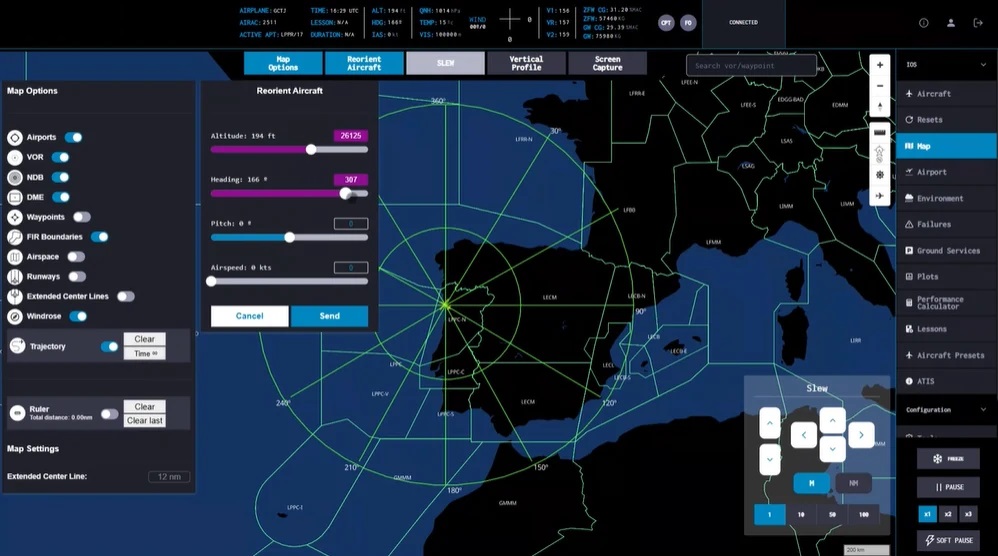
Flight dynamics, multi-crew IOS, scenario and test automation, and EQTG/QTG-native exports developed in-house; aligned to the Production Custom FFS narrative: fastest path to fidelity your type demands, without handing proprietary envelopes and avionics behaviour to a Tier 1 subcontractor chain that owns the revision cadence for decades after qualification.
Discuss Your Requirements
Catalogue physics and borrowed IOS flows cannot sign for your envelope.
VDR and QTG packages require your validation points. When software is assembled offshore from opaque runtimes, your organisation loses direct control of the dataset the authority ties to the training device; the IP exposure OEM buyers name as a multi-decade obligation, not a one-time purchase.
Customer training and type-certification storytelling need your glass, your logic, your failures, not a relabelled Airbus-class IOS where instructors work around wrong cues. That gap is why OEM discovery opens with zero off-the-shelf product for your type.
Aircraft delivery and training-device qualification should track your certification plan. When updates and re-runs route through external release trains, post-certification notifications and configuration control become vendor-paced dependencies; exactly the recurring risk the OEM deck contrasts with in-house architecture.
Engine and IOS built against your data; beside the cockpit and bus layers.
VOA's software pillar is the first layer in the four-layer OEM solution: simulation core and flight dynamics validated with OEM flight test data, instructor tooling and TDMS aligned to your training scenarios, and qualification-oriented automation that feeds EASA/FAA-oriented evidence; engineered with the same team that delivers your custom hardware layout and avionics electronics so configuration states stay one thread.
Flight dynamics and systems behaviour tuned to your provided datasets; the in-house discipline behind A320-class production references, applied to your type
IOS and scenario tooling your programme owns; customer delivery, pilot transition, and support training flows evolve on your engineering calendar
EQTG/QTG-native pipelines where civil qualification paths apply; structured outputs for competent authorities instead of manual recompilation after each build
Image generation and avionics-facing presentation matched to current glass standards, not limited to legacy visuals that undersell your brand at handover
Customisation track: extend an existing device with your aircraft type as a module when infrastructure already exists; same executable discipline, scoped engagement
Same engineering organisation as hardware and electronics; LRU-faithful integration and databus truth stay coupled to the software you qualify